
TEAM Benchmark #7
This example showcases FEEN’s ability to solve the well-known TEAM Problem #7, a well-known benchmark model for eddy currents. It was defined by the ‘Testing of Electromagnetic Analysis Methods‘ (TEAM) group, which was founded with the aim of comparing different computer codes for electromagnetic simulation. The TEAM group meets at regular intervals to work out benchmark problems. Each problem also contains experimental results for validation.
MODEL OVERVIEW
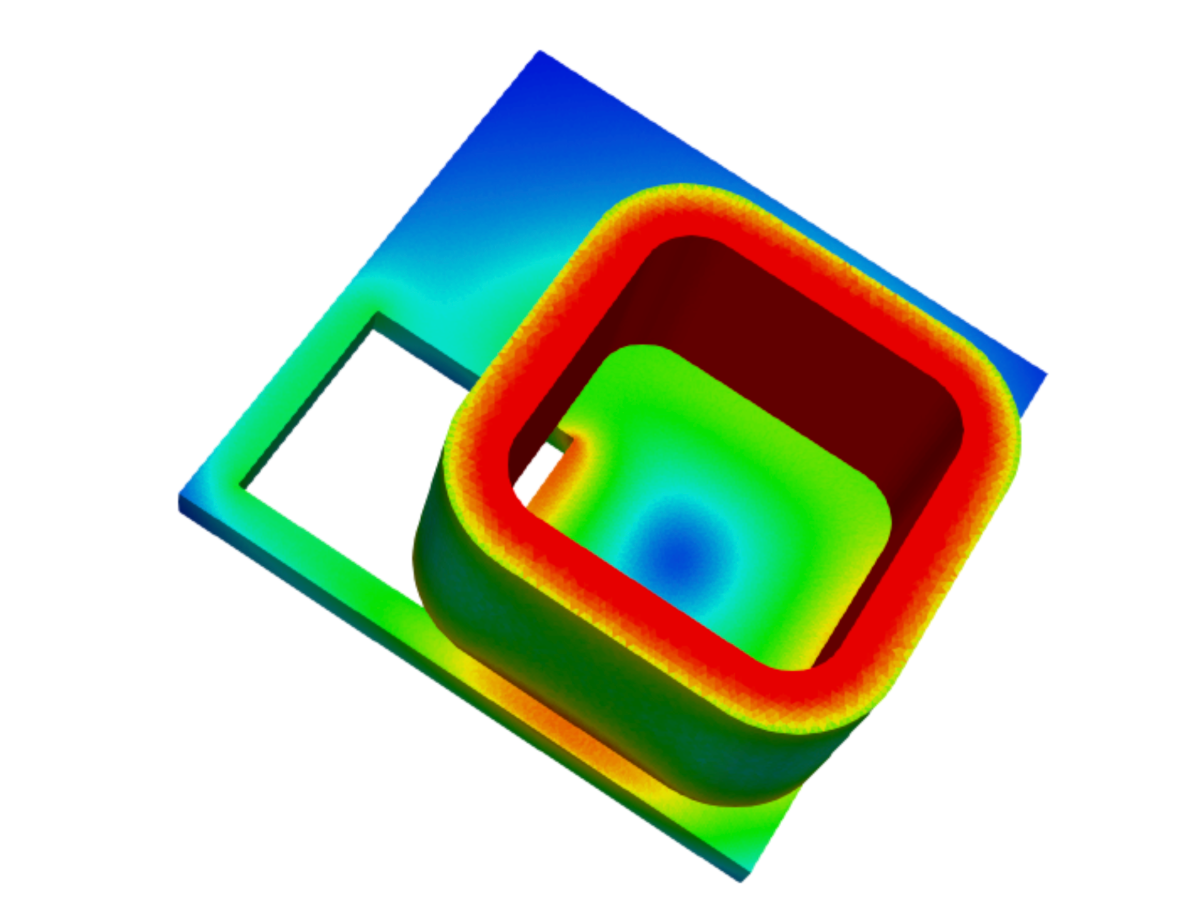
The model is shown in the figure above: A thick aluminium plate (σ = 3.526 107 S/m) with an eccentrically placed hole, situated asymmetrically in a nonuniform magnetic field. This field is generated by a multi-turn coil, with a time-harmonic current of 2742 AT at 50 Hz.
The goal is to calculate magnetic fields and eddy currents at various points within this system. Detailed model descriptions as well as measurement results can be found in the references [1][2] at the end of this article.
FEEN’s APPROACH
FEEN is capable of calculating eddy currents and magnetic fields using both the vector potential approach and the T-Omega method (H-based approach). The results presented here were calculated using the vector potential approach on a Cartesian mesh with hanging nodes.
RESULTS
The figure below shows the magnitude of the real part of the magnetic flux density \(\small{B}\) (i.e. at phase 0°) on the surface of the plate and the coil.
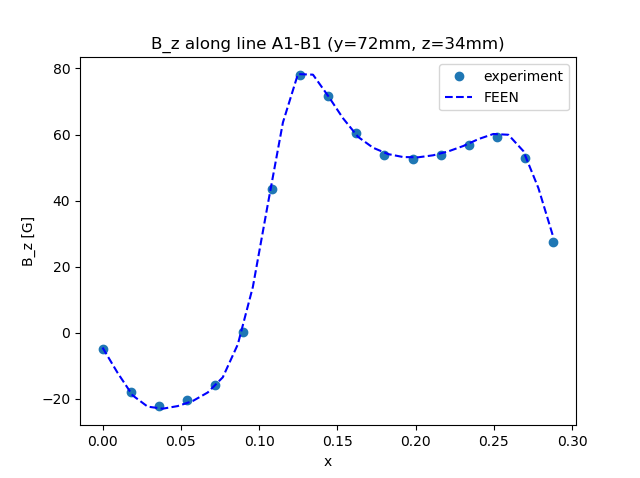
To validate the computed results, we compare them to measurements presented in [1]. The figure below shows \(\small{\mathrm{Re} (B_z)}\) (i.e. \(\small{B}_z\) at phase 0°) along a line between the aluminum plate and the coil. The dashed line represents the results calculated by FEEN, the bullets represent the measurement results. The close match between the two confirms FEEN’s accuracy.
PERFORMANCE
As mentioned, FEEN can run on tetrahedral meshes as well. To get an impression on the speed of FEEN, we have solved the problem on a standard machine (3.2 GHz, 8 Cores, 16 GB RAM). With 1.6 million tetrahedral 1st oder elements. FEEN assembled the system in just 3 seconds and solved it in 15 seconds.
REFRENCES
[1] K. Fujiwara und T. Nakata. Results for benchmark problem 7. COMPEL, 9(3): pp. 137–154 (1990).
[2] https://www.compumag.org/jsite/images/stories/TEAM/problem7.pdf